As I sit down at my desk to write this column on an April morning in Cambridge, Massachusetts, it's snowing. What the heck?
In the little-known opening of "White Christmas," songwriter Irving Berlin laments being stuck on Dec. 24 in California where "the sun is shining" and "the orange and palm trees sway." He longs for the snowy holidays he grew up with.
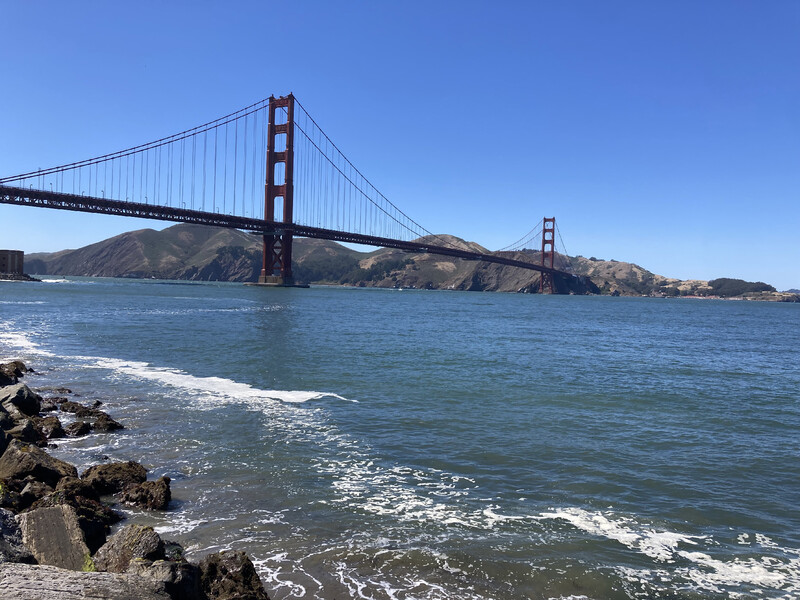
On this April morning, my longings are the other way around. I am missing my home state of California. When I was out there for a writer's conference last month, I sat on a bench overlooking San Francisco Bay with two old friends. Ferries trailed white plumes across blue waters. I could almost hear the ghost of Otis Redding sitting with us on the dock of the bay, singing, "It's two thousand miles I roamed, just to make this dock my home."
I'm a California boy through and through, but I, too, was born 2,000 miles from San Francisco before my parents moved us out to Palo Alto, back then a lazy college town, a half-hour drive south of the city. They bought their first house there for $29,500. (The current owners just sold it for $4.5 million.) Neighbors didn't bother locking their doors. What's now Silicon Valley was called "the Valley of Heart's Delight," known for the delectable fruit of its cherry and apricot orchards.
My dad worked at Ampex, the developer of the first practical videotape recorder. As a teenager, I sold Cokes at Stanford football games. The university had not yet climbed to the top five of world rankings, nor had Apple, Google, Facebook or Tesla been founded. What was coming, though, was already in the air.
I'd sneak up to San Francisco to hear the music of the Doors and Jefferson Airplane. My friend Loren and I used to take public transportation up to windy Candlestick Park to root for the Giants against their archenemy, the Los Angeles Dodgers.
California shaped my life again in the early days of the commercial internet. Nowhere else could a history major like me have helped build an award-winning internet company. The sense of possibility wasn't just culture. It was encoded in the DNA of us Californians. The state didn't just allow for reinvention; it embraced it.
And yet, we keep hearing that California's best days are behind it. We've heard that before, and each flare-up of Californiphobia has proven misguided.
More than 1 in 9 Americans still choose to live in the Golden State. It remains a magnet for the best and brightest who want to be where the action is in tech, movies and fashion. With artificial intelligence as the engine, Silicon Valley remains the dominant center of world technology.
Over 60% of all U.S. venture capital investments flowed to California last year. In addition, University of California researchers set a record in 2025 for the most Nobel Prizes awarded to a single university system in a year.
Even while President Donald Trump sends Marines to occupy Los Angeles, the California economy has become the fourth largest in the world, larger than that of Japan, France, India, the U.K. and Russia.
I do miss the forward thinking of Silicon Valley when here on the East Coast. Early readers have told me my upcoming novel is science fiction. Sure, maybe to them, but in California it's set the day after tomorrow.
Trump looks backward, as shown by his slogan, "Make America Great Again." We Californians look ahead to progress and better days. Trump attacks immigrants. Californian Ronald Reagan once said immigrants "renew our pride and gratitude in the United States of America, the greatest, freest nation in the world."
Don't get me wrong. I do love being in Massachusetts teaching, advising and writing. My own kids tell me living among students keeps me young. Still, the anti-Irving Berlin in me longs for what the Golden State offers: the people, the excitement, the beaches, the mountains, the redwoods, the cities, the farms, the movie studios, the music, the bridges, the technology breakthroughs.
While I watch snow flurries through my windows here, I recall Tony Bennett singing of leaving his heart out West. I cannot wait until the semester is over when I will be "going home to my city by the Bay."
A renaissance man, Keith Raffel has served as the senior counsel to the Senate Intelligence Committee, started a successful internet software company, and had six books published including five novels and a collection of his columns. He currently spends the academic year as a resident scholar at Harvard. You can learn more about him at keithraffel.com. To read features by other Creators Syndicate writers and cartoonists, visit the Creators website at creators.com
DIST. BY CREATORS



View Comments